Ask a longtime Wellesley resident when Fuller Brook Park was built and you'll usually get the same answer: 1899, give or take. It's the number stamped on the town's own facility page, the one that gets repeated at every garden club talk and Wonderful Wellesley Weekend cleanup. What that number leaves out is that most of the path under your feet right now, the granite curbing, the raised boardwalk sections, the stone markers you pass without reading, dates to a construction project that wrapped up less than a decade ago. The brook is old. The path you're walking is not.
That gap between how old the park feels and how recently it was rebuilt is the whole story here, and it explains a few things regular walkers, runners, and dog-owners have probably wondered about without ever chasing down an answer.
A park built to move water, not just people
The Brook Path runs roughly parallel to Washington Street through the center of town, following Fuller Brook and its tributary, Caroline Brook, for what the town's own facilities page describes as more than three miles. Other sources put it closer to 2.5 miles, and you'll occasionally see 2.2. That's not sloppy record-keeping. Different counts include or exclude different connector segments, like the Guernsey Path spur near Dover Road, so the honest answer is that how long your walk is depends on where you consider the park to end.
What every source agrees on is why the land was set aside in the first place. The town established Fuller Brook Park in 1899 for two reasons at once: to fix drainage in a flood-prone stretch of the town center, and to give residents parkland near the center of town. Fuller Brook's watershed collects stormwater runoff from more than half of Wellesley before it eventually reaches the Charles River by way of Waban Brook. Every time you walk past the brook on a rainy afternoon, you're standing next to town infrastructure that happens to look like a nature trail.
The boulevard that almost happened
Here's the part most walkers don't know. The naturalistic, meandering feel of the path wasn't a given. In 1897, John Charles Olmsted, nephew of Frederick Law Olmsted, was briefly consulted on the park's design, and Warren H. Manning, who trained in the Olmsted office before starting his own firm, helped with early land acquisition. Both leaned toward keeping the brook's course looking unplanned.
Then in 1915, engineer and landscape designer Ernest W. Bowditch, who had also worked on Wellesley's sewer system, recommended extending the park and running a formal boulevard alongside the brook. That recommendation was never followed. It's worth sitting with that for a second: the quiet, winding walk you take today, with private lawns backing up to the path between Wellesley Avenue and State Street, could just as easily have been a paved roadway with a grand median. Someone in 1915 said no, and the version of the park you know is the result.
Three years of work most people watched without knowing what it was
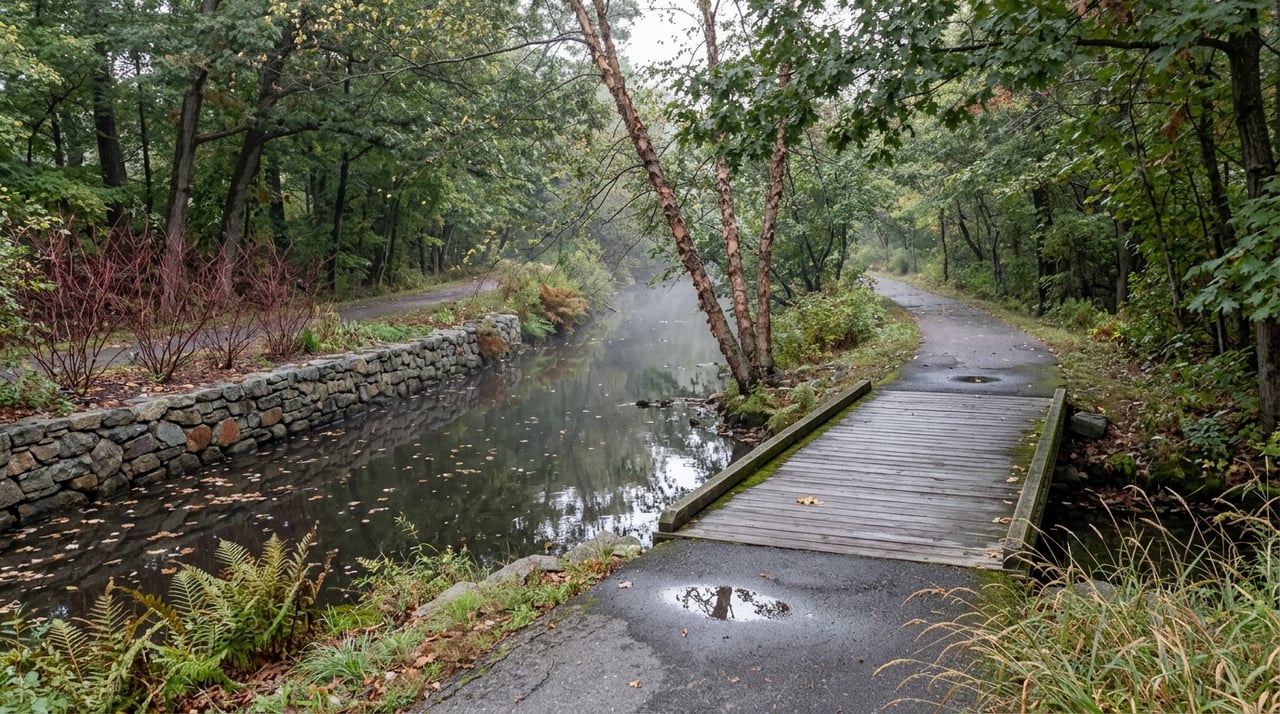
If you've lived in Wellesley long enough, you probably remember years of orange fencing, exposed streambanks, and detours somewhere along the path sometime in the mid-2010s. That was a roughly $6 million restoration that broke ground in July 2014 and wrapped up in late 2017, carried out by outside contractor R. Bates & Sons. The scope went well beyond repaving:
- Raised walkways and new boardwalk sections in the wetter stretches
- Bioretention basins installed to filter stormwater and improve water quality in both Caroline and Fuller Brooks
- Roadway drainage work and new granite curbing to keep contaminants out of the brook before they reach it
- Stone markers, benches, and interpretive signage along the route
- More than 25 species of grasses and flowering plants added to attract insects, birds, and small mammals
- Boulder clusters placed in the stream itself to rebuild habitat structure
The project wasn't uneventful. A macroburst tore through Wellesley on the afternoon of July 18, 2016, and hit the section of the park between Grove Street and Dover Road especially hard, downing large old maples, oaks, and pines and briefly cutting off the contractor's access. Crews had to clear the path, then the construction route, then the brook itself before work could continue.
By August 2017, the project was done, and the town held a pizza lunch to thank the crew, R. Bates & Sons project manager Jim Learned, site superintendent Kevin Coughlin, and DPW project manager Peter Jackson among them, for three years of work most residents experienced only as detour signs and the occasional dump truck. A large portion of the park was added to the National Register of Historic Places in 2013, while the physical path itself was mid-rebuild. The historic designation and the modern engineering happened almost on top of each other, which is part of why the place reads as both preserved and quietly current at the same time.
Five stretches, five different moods
Part of what makes the Brook Path interesting to walk regularly is that it doesn't feel like one park. It changes character block by block:
Between Dover Road and Grove Street, it's unpaved woodland, the closest the path gets to feeling remote, and it connects to the Guernsey Path and Wellesley College's Nehoiden Golf Course.
Between Grove Street and Wellesley Avenue, the path becomes more developed and partly paved as it nears Wellesley Square, with Dana Hall School and Hunnewell School close by.
Between Wellesley Avenue and State Street, it runs behind private lawns, one of the quieter, more residential feeling sections.
Between State Street and Rice Street, the path turns into the busiest stretch, paved and active, running past Hunnewell Fields, the high school, and the skating pond. This is also where it links up with the Crosstown Trail.
From Seaward Road down to Washington Street, the route passes through Phillips Park before ending near Clock Tower Park, with buildings close enough to the path that the secluded feeling from the northern stretches disappears entirely.
If you only have twenty minutes, the Rice Street to State Street stretch gives you the most activity per block. If you want something closer to a quiet walk in the woods, Dover Road to Grove Street is the better bet.
Who actually keeps it looking like this
None of this stays maintained on its own. Since the restoration wrapped, a volunteer group called Friends of Fuller Brook Park has organized the park's ongoing care, most visibly through a cleanup during Wonderful Wellesley Weekend each May. The work is broken into eight sections, from Maugus Avenue to Seaward Road at one end down to Brook Street to Grove Street at the other, each with its own volunteer captain coordinating litter pickup and downed-branch removal. The Natural Resources Commission has also run workshops training volunteers to identify and remove invasive plants along the banks, the unglamorous work that keeps the restored plantings from getting crowded out.
It's a small, mostly invisible system, a handful of neighbors with clipboards and section assignments, that's the actual reason the path still looks the way it did the year the ribbon got cut.
Why this is worth knowing if you already live here
Nobody needs a reason to walk a path they already love. But knowing what you're looking at changes the walk a little. That granite curbing near Wellesley Square isn't original Victorian infrastructure, it's ten years old. The boardwalk that keeps your shoes dry in the wetter sections exists because a construction crew spent three years, including one storm-delayed summer, putting it there. And the fact that the path still looks untouched, rather than freshly built, is the direct result of a small volunteer network that shows up every May with trash bags and section maps.
If you've ever wondered what it would be like to have this path as your regular route rather than an occasional destination, that's a conversation worth having. Laura Wurster works with buyers and sellers across Wellesley and the surrounding towns and can talk through what's actually available near the neighborhoods this path runs through. Schedule a consultation to start that conversation.