If you are hoping to live in Wellesley and rely less on your car, the good news is that it can be done in the right location. The key is knowing that Wellesley is not one uniformly walk-everywhere town. Instead, it works best as a network of village centers, trails, and transit connections that can make daily life easier on foot. If you understand how those pieces fit together, you can choose an address that better supports the routine you want. Let’s dive in.
How walkability works in Wellesley
Wellesley’s walkability is organized around several commercial areas rather than one central downtown. The town identifies Wellesley Square, Wellesley Hills, the Fells area, and Linden Square as commercial villages or shopping districts. Town parking information also points to Wellesley Square, Wellesley Hills, and Wellesley Farms/Lower Falls as major business districts.
That matters because your day-to-day experience will depend a lot on where you live. A home near one of these village centers may give you easier access to errands, dining, and local services on foot. A home farther away may still offer beautiful walking routes, but not the same convenience for everyday tasks.
Best areas for a car-light lifestyle
The strongest car-light lifestyle in Wellesley is generally found where commercial destinations, transit access, and walking routes overlap. Based on the town’s layout, that often means areas near Wellesley Square, Wellesley Hills, Linden Square, and the Lower Falls river corridor.
These locations tend to offer the most practical mix of walkable destinations and transportation options. If your goal is to walk to a train, use local services without driving every time, or combine errands into one trip, proximity to these nodes can make a real difference.
Wellesley Square
Wellesley Square is one of the clearest examples of a compact, on-foot destination. The town lists meters on Central, Cross, Abbott, Church, Washington, and Grove Streets, along with nearby longer-stay lots. That pattern suggests a district built around short trips, easy circulation, and multiple nearby stops.
For buyers, this often means convenience is closely tied to address. If you are within comfortable walking distance, you may find it much easier to handle routine outings without getting in the car.
Wellesley Hills
Wellesley Hills is another important village center in town. It is recognized as both a business district and part of Wellesley’s broader village pattern. For someone seeking a more walkable daily routine, that mix can support errands and local movement more easily than a more residential area set farther away from services.
Linden Square and Lower Falls
Linden Square and Lower Falls help round out Wellesley’s walkable pattern. Lower Falls also benefits from connections near the river corridor, which ties recreation and movement together in a practical way. In the right spot, that can support a lifestyle that feels connected without requiring a car for every short trip.
Transit makes walkability more useful
In Wellesley, sidewalks and trails are only part of the story. Transit is a major reason some parts of town can support a car-light routine. The town notes that Wellesley has three regional rail stops, with daily MBTA commuter rail service on the Framingham/Worcester Line.
That rail access helps extend your reach beyond what is possible on foot alone. You may walk to a station, take the train for work or appointments, and still enjoy a more local, lower-car routine at home.
Wellesley Square station accessibility
Wellesley Square station has seen important accessibility improvements. The town reported in February 2025 that the MBTA mini-high platforms there were ready for use, and later town reporting in October 2025 said the station became fully accessible after platforms on Tracks 1 and 2 were installed.
For many buyers and renters, station accessibility is not a minor detail. It can shape how usable transit feels in everyday life, especially if you are planning around convenience, mobility needs, or long-term flexibility.
Local transit options beyond rail
Wellesley also offers transit options that help fill the first-and-last-mile gap. The town describes Catch Connect as a microtransit service that serves anywhere in Wellesley and also links to Woodland and Waban, Needham Heights, Natick Community Center, and Newton-Wellesley Hospital.
MWRTA Route 1 is another useful option. It runs through Wellesley Square, Babson College, MassBay, Lower Falls, and on to Woodland Station. Together, these services can make it easier to connect neighborhoods, village centers, and regional transit without driving every segment yourself.
Trails that support everyday movement
One of Wellesley’s biggest strengths is that walking here is not limited to sidewalks alone. The town says its trail system includes about 48 miles of trails, with 30 marked network trails. That gives residents a wide range of options for both recreation and practical movement.
Some communities have lovely walking spots that function mainly as weekend amenities. Wellesley’s trail system goes further by helping connect neighborhoods, open space, and, in some cases, everyday destinations.
Brook Path
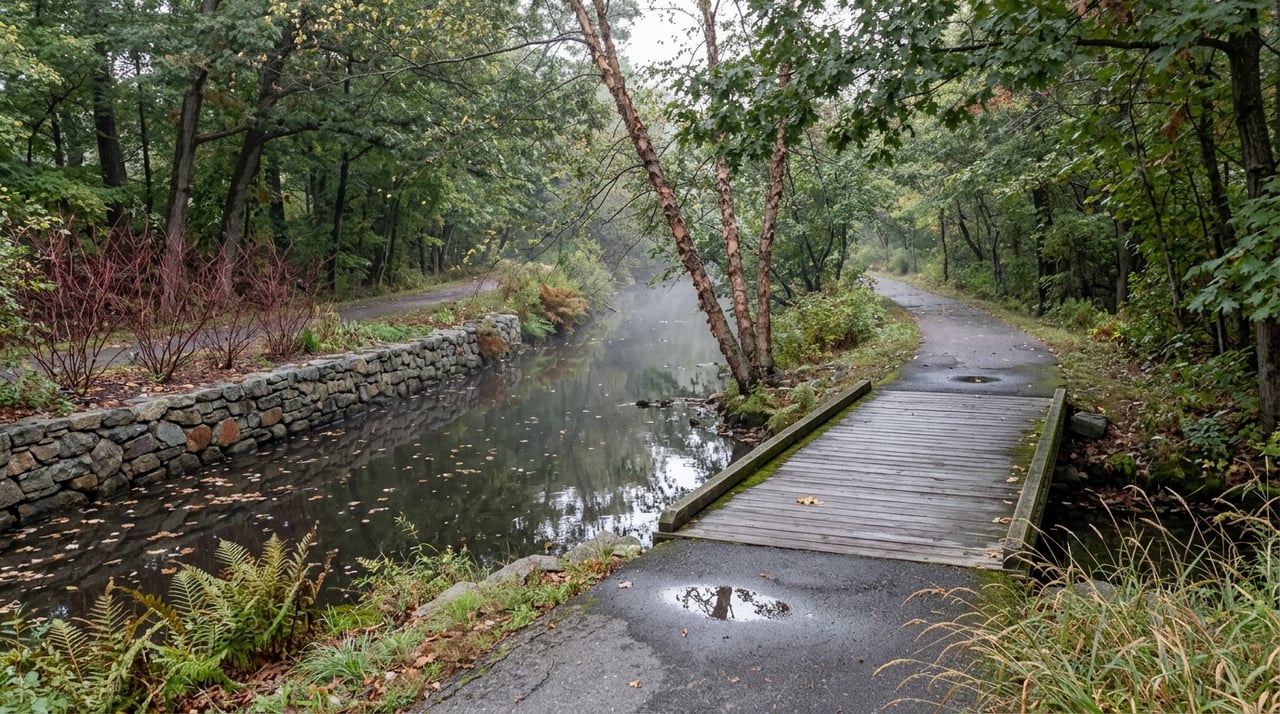
Brook Path is one of the most important walking corridors in town. The town calls it the most popular trail for walking, jogging, and bicycling, and describes it as ADA-accessible. It also runs parallel to Washington Street and is accessible from multiple cross streets.
That makes Brook Path more than just a scenic route. It is one of the clearest examples of a trail that can support regular movement across town in a low-stress setting.
Crosstown Trail
The Crosstown Trail adds another meaningful east-west connection. The town highlights segments from Weston Road along the aqueduct to Route 9, and from Woodlawn Avenue along the aqueduct to Walnut Street.
For buyers comparing locations, routes like this can shape how connected a neighborhood feels. A home near a strong trail corridor may offer easier walking options even if it is not directly in a commercial center.
Charles River Trail and longer routes
The Charles River Trail at Wellesley Office Park is another useful low-stress option. The town describes it as ADA-accessible, with multiple stops along a paved path and river views. That combination can make it appealing for both short outings and more regular walking.
For a bigger-picture example, the Wellesley Grand Tour is a 10.8-mile loop linking Brook Path, the Wellesley Hills Post Office, Crosstown Trail, Charles River Path, Sudbury Path, and Guernsey Path, with less than 3 miles on roads. Wellesley also connects into the 16.5-mile Charles River Link, with the first 7 miles using the town’s trail network.
What to look for when buying
If walkability is part of your home search, it helps to think beyond a general town reputation. In Wellesley, the better question is whether a specific address connects well to the places and routes you plan to use most.
A practical home search may include questions like:
- Can you walk to one of the village centers?
- Is a commuter rail stop realistically nearby?
- Are there trail connections that support regular movement?
- Would daily errands still require frequent driving?
- Does the location support your routine in all seasons?
This is where local guidance matters. Two homes in the same town can offer very different day-to-day experiences depending on how close they are to village centers, transit, and connected walking routes.
Wellesley is improving pedestrian access
Wellesley is also actively working to improve pedestrian conditions. The town’s 2025 Safe Routes Plan aims to build a connected network of low-stress routes between key destinations. It also identifies sidewalk gaps on Worcester Street, Washington Street, Central Street, and Weston Road.
The town’s Complete Streets program adds to that effort. It notes that grants can fund sidewalks, bicycle paths, crosswalks, curb extensions, and street trees for pedestrian comfort, and Wellesley has reported approval of its 2025 Complete Streets Prioritization Plan along with $882,000 in Complete Streets funding.
That does not mean every part of town already functions the same way. It does mean Wellesley is taking measurable steps to improve how people move around without relying only on a car.
The bottom line on walkable Wellesley
Wellesley can absolutely support a car-light lifestyle, but it is highly address-dependent. The town’s overall pattern is best described as village-center plus trail plus rail. When those elements line up near the home you choose, getting around without the car becomes much more realistic.
If you are buying, selling, or renting in Wellesley, it helps to evaluate not just the home itself but also how the location fits your everyday routine. That kind of detail can have a big impact on convenience, resale appeal, and how a property lives over time.
If you want help identifying Wellesley locations that match the way you actually live, schedule a consultation with Laura Wurster, a local broker who brings clear guidance, strong process management, and a thoughtful understanding of how neighborhood location affects daily life.
FAQs
Is Wellesley a walkable town for daily errands?
- Wellesley can be walkable for daily errands in certain areas, especially near village centers like Wellesley Square, Wellesley Hills, Linden Square, and Lower Falls, but it is not uniformly walkable across the entire town.
Which Wellesley areas are best for living without a car?
- Areas near Wellesley Square, Wellesley Hills, Linden Square, and the Lower Falls corridor generally offer the best mix of commercial destinations, trails, and transit access for a car-light lifestyle.
Does Wellesley have commuter rail access?
- Yes. The town says Wellesley has three regional rail stops with daily MBTA commuter rail service on the Framingham/Worcester Line.
What trails in Wellesley are useful for everyday walking?
- Brook Path is one of the most useful everyday corridors, and the Crosstown Trail and Charles River Trail also provide meaningful walking connections in town.
Is Wellesley improving sidewalks and pedestrian routes?
- Yes. The town’s 2025 Safe Routes Plan and Complete Streets program show ongoing efforts to improve low-stress connections, sidewalks, crosswalks, and other pedestrian features.