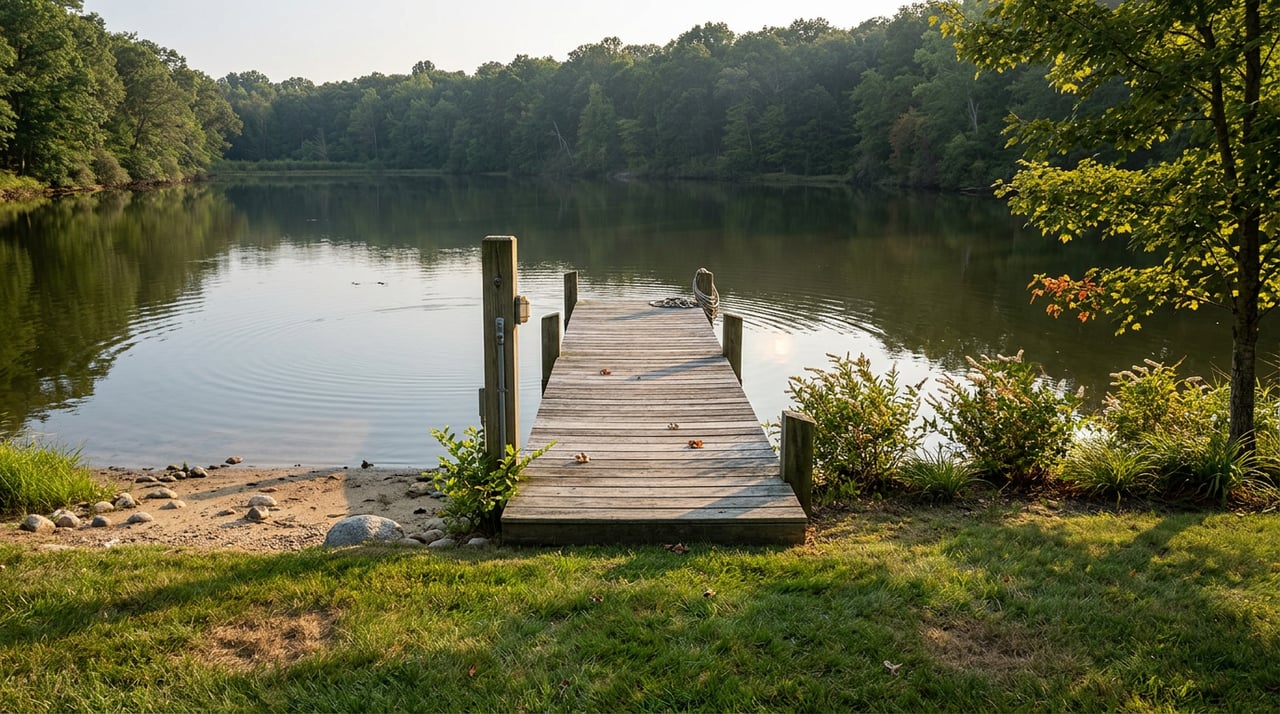
The parking lot off Turner Road fills early these mornings. Towels are already staked out on the grass above the beach by 9:30, a half hour before the lifeguards even take their chairs. It has the feel of a countdown, because it is one. This Sunday, August 16, is the last day Wellesley's Recreation Department puts lifeguards on the sand at Morses Pond for the year. After that, the pond does not close. It just stops promising anyone will be watching.
That gap between "the season ends" and "the pond is done" is the part most people miss, and it is exactly the gap the town is now building a piece of hardware to manage.
Lifeguards Through Sunday, August 16
Beginning Monday, June 22 through Sunday, August 16, lifeguards will be on duty daily at the beach from 10 a.m. to 5 p.m. As of today, there are only a few more days of supervised swimming, deep-water testing, and slide access before the chairs come down for the season. During beach hours, runners, walkers, and dogs are not allowed in the beach area, a rule that has quietly shaped foot traffic patterns around the pond all summer.
Even now, the supervision window is narrower than the pond's actual hours. Park rangers are on duty from 5 p.m. to dusk, and swimming during evening hours is already at your own risk. So the town has been running a two-tier system all season: fully lifeguarded mornings and afternoons, ranger-monitored but unguarded evenings. What changes on August 17 is that the first tier disappears entirely. The pond keeps its rangers, its trails, and its gate, but the person watching the water is gone until next June.
The Gate the Town Is Building for the Week After
This is where the interesting part starts. The Swellesley Report reported that on February 9, 2026, the town of Wellesley sent out a request for bids to furnish and install a pair of automated vehicle gates at the entrance to the Morses Pond property at 100 Turner Road. Right now, the yellow metal gate on Turner Road is locked and unlocked manually, typically by town staff or the Wellesley Police. That is a fine system when the schedule is simple. It becomes a real headache when warm September afternoons keep drawing people to a pond the town has technically stopped staffing.
The new gate is built for that exact problem. It will be programmable to open and close at designated times, days, and dates, including automatic exiting so drivers are never locked in, and a remote mobile app will let the town operate the gate from anywhere. The town has said as much directly: the app will come in handy once the pond is officially closed for the season but warm weather continues and people still want to access the trails or hang out on the beach.
There is a second, more local reason behind the project. Neighbors in the Woodlands area have asked the town for years to manage the parking lot better, citing times when their streets have been overrun with vehicles, sometimes blocking gate or emergency access. An automated system that can be scheduled and monitored remotely solves both problems at once: it keeps the shoulder-season crowd from turning into an on-street parking free-for-all, and it gives the town a way to open the gate on a warm October Saturday without sending someone to unlock it by hand.
It is a small piece of municipal engineering, but it says something real about how the town thinks of the pond. MOPO's own tagline is "the beach within reach," and the gate project is the town admitting that reach needs to extend further into the calendar than the lifeguard schedule currently allows.
| Lifeguarded Season (through Aug. 16) | Shoulder Season (Aug. 17 on) | |
|---|---|---|
| Beach hours | 10 a.m. to 5 p.m., lifeguards on duty | Rangers on duty until dusk, no lifeguard |
| Swimming | Supervised, swim tests required for slide/deep water | At your own risk |
| Trail and gate access | Turner Road gate open 10 a.m. to dusk | Same gate hours, soon to be app-managed |
| Concerts and programming | Sunday concert series, camp pickups, bird walks | Informal use only |
What Still Works After the Whistle Stops
Losing the lifeguards does not shrink the pond. If anything, the part of Morses Pond that keeps functioning year-round, the trail network, gets more use once the beach crowd thins out.
The North Forty is part of a 113-acre contiguous open-space corridor along Morses Pond running from Route 9 to Weston Road, with 5.3 miles of walking trails and only two road crossings. That is a genuinely large, low-traffic loop for a town this size, and it stays open on the same schedule as the gate, independent of whether anyone is guarding the water. The Crosstown Trail connects to it through the Cochituate Aqueduct, with access points at the Morses Pond Access Road and at the Weston Road electric substation.
The town has also used the pond as a hub for programming that has nothing to do with swimming. This year's Wellesley Wonderful Weekend included a Morses Pond Guided Bird Walk starting at 8 a.m. from the Turner Road entrance, timed for exactly the kind of quiet, unsupervised early morning that will define the pond for the rest of the fall. If you have never walked the North Forty before 9 a.m., late August and September are the window before it gets cold enough to matter.
Before You Head Down This Week
A few things worth knowing if you're making a last run at the beach before Sunday:
- Season passes run $25 for an individual (adult, senior, or child) and $100 for a family sharing one household, still available through the Recreation Department for the final stretch.
- Kayak and paddleboard rentals are priced by the half hour: $5 for a one-person kayak, $10 for a two-person kayak, and $10 for a stand-up paddleboard, with rentals handled first-come, first-served and a life jacket and whistle included with every rental.
- Swim testing for the slide or deep water requires continuous swimming for 50 meters using breaststroke or front crawl, followed by 30 seconds of treading water, administered by the on-duty lifeguards while they're still there.
- The last concert of the summer lands on closing day itself. The Recreation Department's Sunday concert series at the pond runs 2 to 4 p.m., with its final date on August 16, and this season's outdoor concerts have featured the band Roger That!
- Grill and pavilion rentals are $5 per two hours for a single grill and $10 per two hours for a double grill pavilion for residents, with non-resident rates roughly quadrupled, bookable through the Morses Pond Beach Office.
If you've been putting off the trip because the beach always looks packed by midmorning, the smarter play is early evening. Rangers are already on duty by five, the crowd thins fast once the lifeguards' shift ends, and the light on the water gets better anyway.
The Real Story Is the Gate, Not the Calendar
It would be easy to read all of this as a simple "summer's ending" post. It isn't, really. The lifeguard season ending on a fixed date every year is nothing new. What's new is a town government looking at the gap between when it stops officially watching the water and when people stop actually wanting to use it, and deciding that gap is worth engineering around rather than just posting a sign about.
That is a small, unglamorous kind of civic attention, and it is the same kind of attention that shows up in how a town maintains its trail crossings, its aqueduct easements, and its neighborhood parking rules. Morses Pond is getting a smarter gate this year, one practical way to manage access beyond the lifeguard season.
That is the version of Wellesley worth knowing, whether you're heading to MOPO for the last swim test of the season or you've lived three streets over for twenty years and never once needed the beach house schedule.
If you're weighing what it actually means to put down roots in a town that pays this kind of attention to the small stuff, Laura Wurster has spent her career working the space between neighborhood knowledge and the fine print that comes with it. Schedule a consultation to talk through what a move to Wellesley, or within it, actually looks like.